40 Days From Today Calculator
Forty days is two days short of six weeks. Count it as six weeks and the date lands two days late, before any work has even started. Five weeks, plus five days. That is the whole trick on this page, and the tool below does it for you, weekday included. For a different stretch, try the main Date Calculator.
What is 40 days from today?
40 days from today lands just under six weeks out. Think of it as a short project sprint, a review period, or a 40-day challenge, all things people actually use this length for. Here is the part that trips people up. A 35-day stretch lands on the same weekday you started on. Forty days does not. The weekday jumps forward by five, so Friday becomes Wednesday. Say it out loud: the weekday moves, it never stays put.
What is 40 days from now?
40 days from now means the same as 40 days from today. Count 40 days forward from today and you land on the date. For example, 40 days from Monday, 16 November 2026 is Saturday, 26 December 2026. That is 5 weeks and 5 days, so the weekday moves forward by five days. A shorter stretch works differently. See what date is 35 days from today, which lands on the same weekday you started on. To see the same 40 days counted in weeks, read how many weeks is 40 days.
Using the tool
- Start with the tool at the top. It is already set to add 40 days to today. The green answer says: The date is Friday, January 1, 2027.
- Change the 40 to any number you like and the green answer changes at once.
- Need workdays only? Tick the box that says Count business days only (skip Saturdays and Sundays). The result leaves out weekends and US holidays.
Formula and method
Result date = start date + 40 days.
That is the whole formula. One addition, nothing else hiding in it. Business days work the same way, then Saturdays and Sundays get skipped, along with US federal holidays. Why does the weekday change at all? Because 40 days is not a whole number of weeks. Five weeks would bring you back to the same weekday. The extra five days push you forward, Friday to Wednesday, for example. Either way you count it, by weeks or by days, you land on the same date.
Step by step: 40 days from today
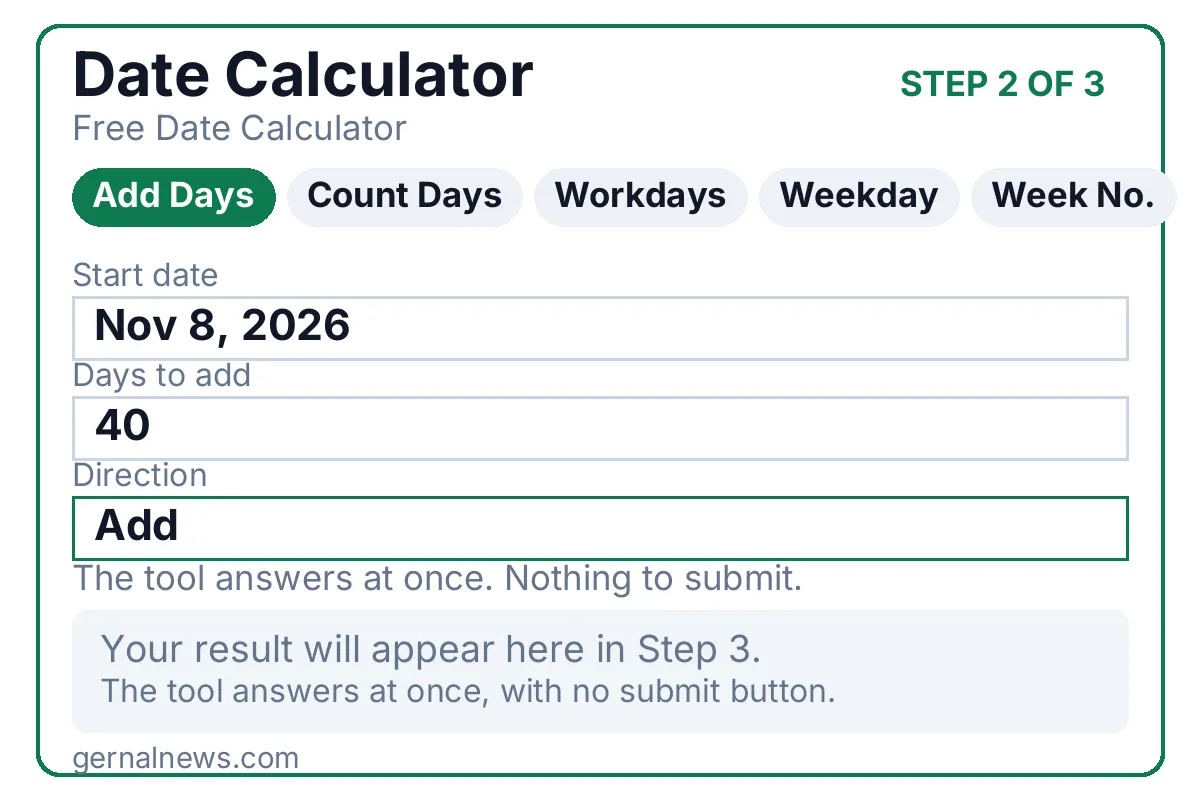
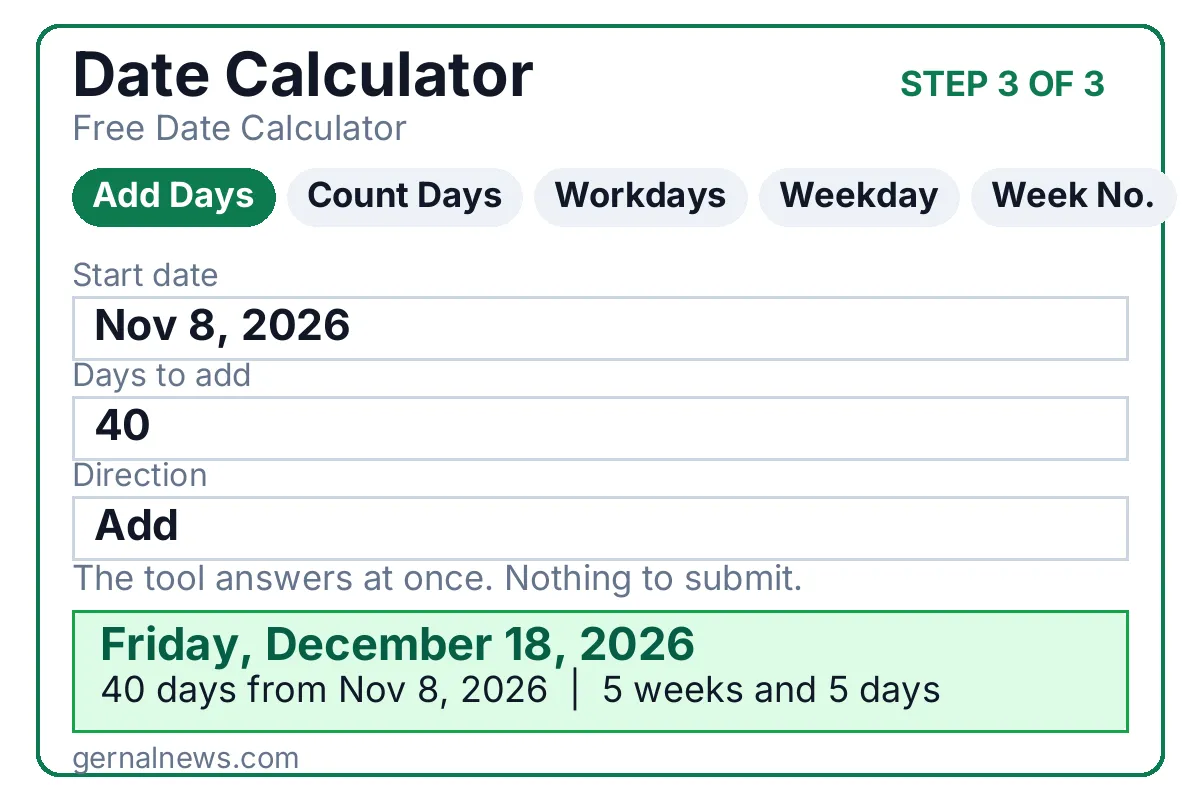
Start on Sunday, November 8, 2026. Add 40 days. You land on Friday, December 18, 2026. Five weeks, plus five days. The pictures below walk through it, one tap at a time.
Add Days: 40 days from November 8, 2026
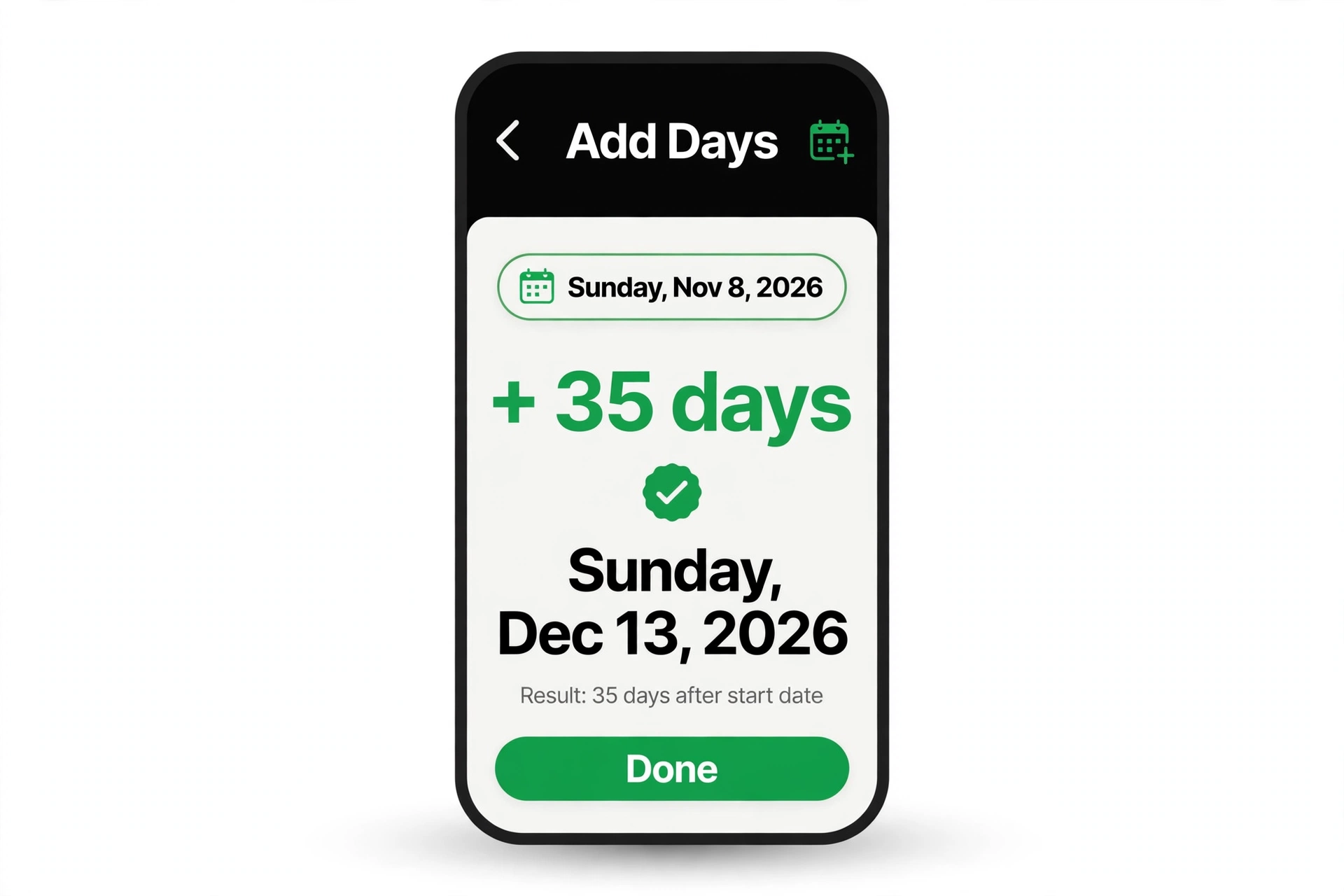
Follow the steps below, then see an Add Days result visual.

Three examples, worked through
Start from Friday, November 6, 2026. Add 40 days and you get Wednesday, December 16, 2026. Try it. Start Monday, November 16, 2026 instead. Where do you land? Saturday, December 26, 2026.
| Start date | 40 days later |
|---|---|
| Friday, November 6, 2026 | Wednesday, December 16, 2026 |
| Monday, November 16, 2026 | Saturday, December 26, 2026 |
| Friday, December 18, 2026 | Wednesday, January 27, 2027 |
Notice what the table never does. It never lands on the same weekday you started on. Five weeks, plus five days. That is why a 40-day deadline is not six weeks, and not a round month either. Type any start date into the tool and it shows the landing date with the weekday beside it.
What this calculator does
Pick a start date and this calculator gives you the date 40 days later, weekday and all. I use it the lazy way. I type a date, glance at the answer, then change the number and watch it move. No reload, no waiting. The answer updates the second you type.
Why show the weekday at all? Because that shift is the part people get wrong most often. Forty days is 5 weeks and 5 days, so the weekday moves forward by 5. A Friday start lands on a Wednesday. A Monday start lands on a Saturday.
Need workdays instead of calendar days? Tick ‘Count business days only (skip Saturdays and Sundays)’ and the calculator skips Saturdays, Sundays and US federal holidays, then gives you the date 40 workdays away. That is the count most people want for a deadline at work, and the same box sits on every tool on this site. You can also go backwards. Choose ‘Subtract days’ in the Direction box and the calculator counts 40 days back from your start date.
No account, no sign up, and nothing you type gets stored. The math happens in your own browser, so the answer is ready in seconds. Phone or desktop, it behaves the same way. Same date, same weekday, either screen.
More dates you can check
Each row below starts on a different date and adds 40 days. Want a quick sense check before you trust the table? Pick any row and count the weekday jump yourself. Five weeks, plus five days. Every row makes the same jump, Friday to Wednesday, Wednesday to Monday, Sunday to Friday. A weekend start still gives you a calendar date, not a workday, so if the answer has to be a working day, tick the business days box first.
| Start date | 40 days later |
|---|---|
| Wednesday, November 11, 2026 | Monday, December 21, 2026 |
| Wednesday, November 18, 2026 | Monday, December 28, 2026 |
| Friday, December 11, 2026 | Wednesday, January 20, 2027 |
| Sunday, January 10, 2027 | Friday, February 19, 2027 |
| Tuesday, February 9, 2027 | Sunday, March 21, 2027 |
| Thursday, November 11, 2027 | Tuesday, December 21, 2027 |
Five slips to watch for
Nearly every wrong answer here traces back to one of five slips. Easy to make, easy to dodge once you spot them.
- Thinking 40 days is 6 weeks. Six weeks is 42 days, so 40 days is 2 days short. Plan for 6 weeks and you will be 2 days late, which is the slip the intro opens with. Count it as 5 weeks and 5 days and the weekday jumps forward by 5, every time. See how many weeks is 40 days for the full breakdown.
- Treating today as day 1. Today is day 0, so 40 days from today lands 40 days after today, not 39. Count from today as day 1 and the date lands one day too early. Our guide to Day 0 vs Day 1: The Most Common Mistake When Counting Days walks through the rule with worked examples.
- Forgetting the weekday moves by 5. Forty days is not a whole number of weeks, so the weekday has to change. Start on a Friday and you land on a Wednesday. Start on a Monday and you land on a Saturday. If your answer shows the same weekday you started on, something is wrong. Check any weekday against an independent calendar.
- Confusing calendar days with business days. 40 calendar days is 5 weeks and 5 days. 40 business days is 8 weeks, because weekends are skipped. That is a whole different date. If you need workdays, tick ‘Count business days only (skip Saturdays and Sundays)’ and let the calculator skip them for you. The US Office of Personnel Management lists the US federal holidays the calculator skips.
- Using 40 days for a monthly deadline. A month runs 28 to 31 days, so 40 days from the 1st of a month lands in the second week of the next month, not on the 1st. If you need a month from today, open the Count Days tab and choose the same date next month instead.
When to use it, and when not to
Bookmark this page for notice periods, follow-ups, delivery dates, and the end of a trial. Forty days is a common length for a notice period, and for a first follow-up after a meeting. Planning a project in workdays? Tick ‘Count business days only (skip Saturdays and Sundays)’ and the answer skips weekends and US federal holidays.
A 40-day project block or a training plan fits here too. Pick your start day and the calculator hands you the finish day. Just under six weeks is long enough to finish a real piece of work, and short enough that the end stays in sight.
Do not trust this answer alone for a legal deadline, a visa date, or a medical schedule. Some deadlines run on business days only, some include the start day, and some skip the day the notice was served. When a date carries real consequences, read the rule that sets it, then check the result against a calendar before you act. A calculator gives you the math. The rule gives you the deadline.
Related calculations
Need a different stretch? Try 35 days from today, how many days until June 1, or what day January 1 falls on, or open the full date calculator on the home page. The counting rules never change between tools, and they are set out in Calendar Days vs Business Days and Day 0 vs Day 1: The Most Common Mistake When Counting Days. Looking further ahead? See our guide to planning 90 and 120 days ahead.
FAQs
What date is 40 days from today?
40 days from today, Sunday, November 22, 2026, is Friday, January 1, 2027. That is 5 weeks and 5 days later.
Is 40 days the same as 6 weeks?
No. Six weeks is 42 days. Forty days is 5 weeks and 5 days.
How many business days is 40 days?
A 40-day stretch from today holds 27 business days, after skipping weekends and US federal holidays.
Also try: Try our 35-day calculator or see how many days until June 1.
What day of the week is 40 days from today?
Monday. Today is Wednesday, November 11, 2026, and 40 days later is Monday, December 21, 2026. The weekday jumps forward by five because 40 days is 5 weeks and 5 days, not a whole number of weeks, so the answer is never the same weekday you started on.
Can I count business days with this calculator tool?
Yes. Tick “Count business days only (skip Saturdays and Sundays)” and the calculator tool counts only business days. A 40-day stretch normally holds 28 business days when no public holiday falls inside.